Video Diffusion Models: Teaching Machines to Imagine Motion
An exploration of how diffusion models are being adapted to generate coherent video sequences from noise.
Introduction: From Noise to Meaningful Motion
Recent breakthroughs in text-to-video generation feel almost surreal. A short sentence, "an astronaut walking through a rainy neon city" can now produce a coherent moving scene with lighting, motion, and atmosphere that feels intentional rather than random.
This is not magic, and it is not brute-force memorization. At its core, modern video generation rests on a surprisingly elegant idea borrowed from statistical physics: diffusion.
This article expands deeply on the idea, connecting diffusion models, Brownian motion, CLIP embeddings, and guidance techniques into a single mental model for how text becomes video. The goal is not just to explain what works, but why it works.
Diffusion as a Physical Process
Brownian motion in high dimensional space
In physics, Brownian motion describes the random movement of particles suspended in a fluid, constantly jostled by microscopic collisions. Mathematically, this is modeled as a stochastic diffusion process — a random walk governed by probability.
Diffusion models borrow this idea almost verbatim.
An image (or video) can be represented as a single point in a very high-dimensional space:
- A 512x512 RGB image: ~786,000 dimensions
- A short video clip: millions of dimensions
When we add Gaussian noise to an image repeatedly, we are effectively performing Brownian motion in this space, slowly destroying structure until all samples resemble pure noise.
The remarkable insight behind diffusion models is this: If we can model how structure disappears under noise, we can learn how to reverse that process.
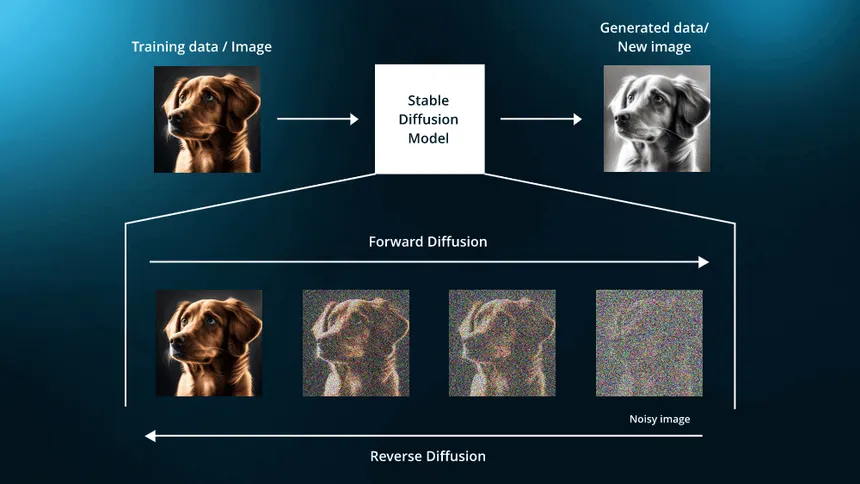
The Forward and Reverse Diffusion Processes
The forward process: destroying information
During training, diffusion models apply a forward process:
- Start with a real image or video
- Add a small amount of Gaussian noise
- Repeat for hundreds or thousands of steps
Eventually, every input converges to the same thing: isotropic Gaussian noise. Crucially, this forward process is fixed and known. There is no learning involved here.
The reverse process: learning structure
The challenge lies in learning the reverse process:
- Given a noisy sample at time t
- Predict how to move it slightly back toward the original data distribution
Instead of learning a single denoising step, DDPMs (Denoising Diffusion Probabilistic Models) train a neural network to predict the total noise added at each timestep.
This transforms generation into an iterative refinement procedure: noise → less noisy → structured → realistic
Each step is small, local, and statistically well-behaved, which is why diffusion models are stable to train compared to GANs.
Why Noise Is Added Even During Generation
If we remove randomness during generation, the model collapses toward the mean of all plausible outputs. The result is blurry images and dull videos.
Noise injection keeps the model sampling from the full distribution, allowing sharp edges, diverse outputs, and multiple plausible futures.
In short: Noise prevents the model from playing it safe.
DDPM vs DDIM: Stochastic vs Deterministic Paths
DDPM: stochastic sampling
DDPM treats generation as a stochastic differential equation (SDE). Each step includes randomness, which improves diversity but requires many iterations.
DDIM: deterministic shortcuts
DDIM (Denoising Diffusion Implicit Models) reframes the same process as an ordinary differential equation (ODE). Key consequences: no noise needed during sampling, far fewer steps, similar image quality.
Conceptually, DDIM shows that diffusion is not about randomness per se, but about following the learned vector field through high-dimensional space.
Images, Videos, and Vector Fields
An extremely useful abstraction is to think of diffusion models as learning a time-dependent vector field.
- Each noisy sample is a point in space
- The neural network outputs an arrow pointing toward higher likelihood regions
- Time (t) determines whether the arrow focuses on global structure or fine detail
Early steps handle large-scale shapes, composition, and motion trajectories (for video). Late steps handle textures, edges, and lighting.
Enter CLIP: Language Meets Vision
Diffusion alone can generate images, but it cannot understand intent. This is where CLIP (Contrastive Language-Image Pre-training) becomes essential.
A shared semantic space
CLIP consists of two encoders — an image encoder and a text encoder — both mapping inputs into the same 512-dim space, trained so that matching image-text pairs are close and non-matching pairs are far apart.
Concept arithmetic
Because this space is continuous and structured, it supports vector arithmetic:
(image of person with hat) − (image of person without hat) ≈ "hat"
This is not symbolic reasoning — it is geometry. Meaning becomes direction.
Conditioning Diffusion with Language
Text-to-image and text-to-video models work by conditioning diffusion on CLIP embeddings. At every denoising step, the model sees the noisy sample, the timestep t, and the text embedding.
The result is a vector field that is tilted toward regions of space consistent with the prompt. This is not post-hoc filtering — the text actively reshapes the denoising trajectory.
Classifier Free Guidance: Steering the Trajectory
During training, the model learns an unconditional vector field (no text) and a conditional vector field (with text). At inference time, these are combined:
final = uncond + α · (cond − uncond)plain text
Where α controls guidance strength. The difference (cond − uncond) isolates what the text adds. Amplifying it sharpens prompt adherence without retraining the model.
Higher guidance: more literal, more detailed, less diverse. Lower guidance: more creative, more ambiguous.
This single equation explains much of modern prompt engineering.
Negative Prompts and Subtractive Semantics
Video models like WAN extend classifier free guidance with negative prompts. Instead of saying what you want, you also specify what you do not want — extra fingers, distorted faces, unnatural motion.
Mathematically, these are vectors that are subtracted from the generation trajectory. Generation becomes a balancing act of forces in embedding space.
Extending Diffusion from Images to Video
Videos as spatio-temporal volumes
A video is treated as a 3D tensor: (time, height, width, channels). Noise is added and removed across space and time simultaneously.
This forces the model to learn appearance consistency, motion coherence, and temporal causality.
Temporal attention
Modern video diffusion models introduce temporal attention, allowing information to flow across frames. This prevents flickering, identity drift, and inconsistent lighting. Motion becomes a learned pattern, not an accident.
A Unifying Mental Model
All components now fit together:
- Diffusion provides a stable generative backbone
- Physics explains why gradual denoising works
- CLIP embeds meaning geometrically
- Guidance steers trajectories through possibility space
- Temporal modeling turns images into motion
Text-to-video is not a single model — it is a carefully orchestrated system of constraints.
From Static Pixels to Predicting Change
Diffusion models do not understand the world in a human sense. But they have learned something profound: Structure emerges when randomness is reversed carefully.
By combining physics-inspired processes with semantic embeddings and guidance mechanisms, modern AI systems can transform language into dynamic visual narratives.
Video diffusion is not just about better media generation — it is about teaching machines to model change over time. And that may be one of the most important steps toward general intelligence.
Conceptual Diagrams: Forward vs Reverse Diffusion
Forward process (destroying information):
x₀ ──► x₁ ──► x₂ ──► ... ──► x_T
(real)  (+noise) (more noise)  (pure noise)

Reverse process (learned denoising):
x_T ◄── x_{T-1} ◄── x_{T-2} ◄── ... ◄── x₀plain text
Forward diffusion destroys information via random motion. Reverse diffusion learns how to climb back toward structured regions of the data distribution.
CLIP Shared Embedding Space
512-D semantic space:
["dog"]   ←→   [image: dog]
["cat"]   ←→   [image: cat]

Distance ≈ semantic similarity
Direction ≈ meaningplain text
Because text and images live in the same space, a text prompt can directly guide image/video generation.
Further Reading
Denoising Diffusion and Score-Based Models:
- Ho et al., Denoising Diffusion Probabilistic Models (2020)
- Song et al., Score-Based Generative Modeling through Stochastic Differential Equations (2021)
- Song et al., Denoising Diffusion Implicit Models (DDIM) (2020)
CLIP and Language-Vision Alignment:
- Radford et al., Learning Transferable Visual Models From Natural Language Supervision (2021)
Text-to-Image and Latent Diffusion:
- Rombach et al., High-Resolution Image Synthesis with Latent Diffusion Models (2022)
Video Diffusion Models:
- Ho et al., Video Diffusion Models (2022)
- Singer et al., Make-A-Video: Text-to-Video Generation without Text-Video Data (2022)
Guidance and Prompting:
- Ho and Salimans, Classifier-Free Diffusion Guidance (2022)